


Something is shifting in my coaching conversations lately.
The questions people are sitting with feel heavier. And underneath almost all of them is the same unspoken question: what does AI actually mean for me, my team, my work, my plans?
People are watching the ground move in real time. And what I keep noticing is that the hardest part isn’t the uncertainty itself. It’s the conversations people are still avoiding.
In coaching conversations, there is almost always a moment when the tone shifts.
It usually happens around twenty minutes in. The person I’m speaking with has already explained the situation, walked me through the strategy, told me what they think they should do next.
And then they pause.
Sometimes they laugh a little. Sometimes they lower their voice. Almost always, the next sentence starts the same way.
“This might sound crazy, but…” “I probably shouldn’t say this, but…” “The truth is…”
That’s the moment I wait for.
Because everything before that sentence is usually the story they’ve been telling themselves. Everything after it is where the real work begins.
I think of a client I worked with last year who spent the first thirty minutes of our session walking me through a very logical explanation for why her business wasn’t growing the way she’d hoped. Market conditions. Team bandwidth. Timing. All of it reasonable, none of it wrong.
And then she stopped mid-sentence and said: “I think I’m just scared it’s me.”
That was the sentence. Everything shifted from there.
You see this same pattern everywhere right now. In business, in politics, in sports interviews. If you’ve ever listened to a corporate earnings call, it’s most obvious there. People circle the truth for a while before they say it. The language gets careful. The explanations get longer. The phrasing gets softer.
And then someone finally says the thing everyone already suspected.
The strategy isn’t working. I’m not happy doing this anymore. This partnership isn’t aligned. I’m afraid to make the move.
The energy shifts the second that sentence lands.
Not because the problem disappears. But because suddenly there’s something real to work with.
What gets me is how long people can stay in the space right before that moment. We protect the version of the story that feels safer. We explain around the issue. We soften the language so we don’t have to face what we already know.
And part of what we’re protecting isn’t just comfort. It’s the version of ourselves who made the right call, who saw things clearly, who handled it well. Admitting the true sentence sometimes means admitting we’ve known it for a while.
Honestly? I get it. The circling isn’t weakness. Sometimes it’s the mind doing its due diligence, making sure the honest sentence is actually true before we have to do something about it.
Progress rarely starts in the careful explanation, though. It starts in the honest sentence, the one that’s a little uncomfortable to say out loud.
Once it’s spoken, something opens. The options get clearer. The conversation gets simpler. The path forward, even when it’s not easy, becomes visible.
The truth doesn’t solve everything. But it gives you something real to start from.

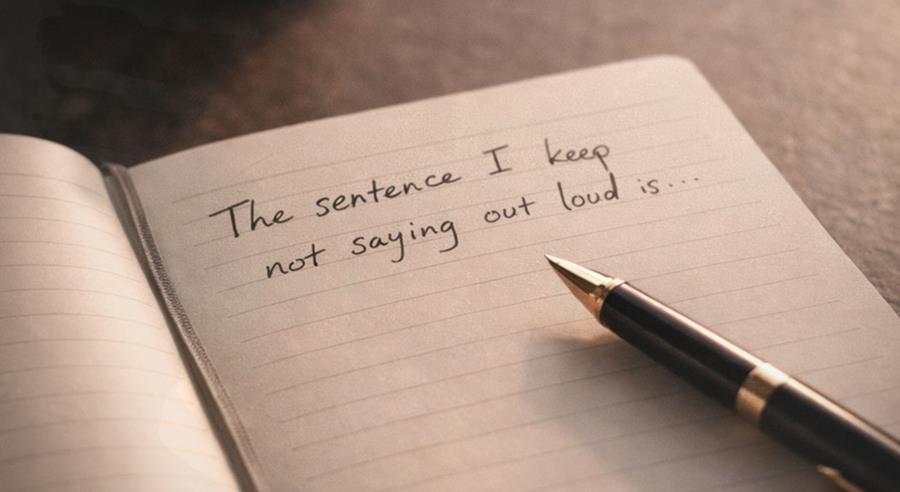
Coaching Corner: Finding the Sentence
If you’re stuck in something right now, try this.
Take ten quiet minutes and write down the answer to one question:
What is the sentence I keep not saying out loud?
Don’t edit it. Don’t soften it. Just write it the way it actually sounds in your head.
Then ask yourself:
- What would shift if I admitted this to myself?
- Is there a conversation I’ve been avoiding?
- What’s one small thing I could do from here?
You don’t have to know what to do with the answer yet. Sometimes writing it down is enough for now.
You don’t have to solve the whole situation today.
But naming it, actually saying the true thing, is almost always when things start moving.
Sometimes the most powerful shift in a conversation isn’t a new strategy or a brilliant insight.
Sometimes it’s just the sentence someone finally lets themselves say.
And from there, the real work can begin.