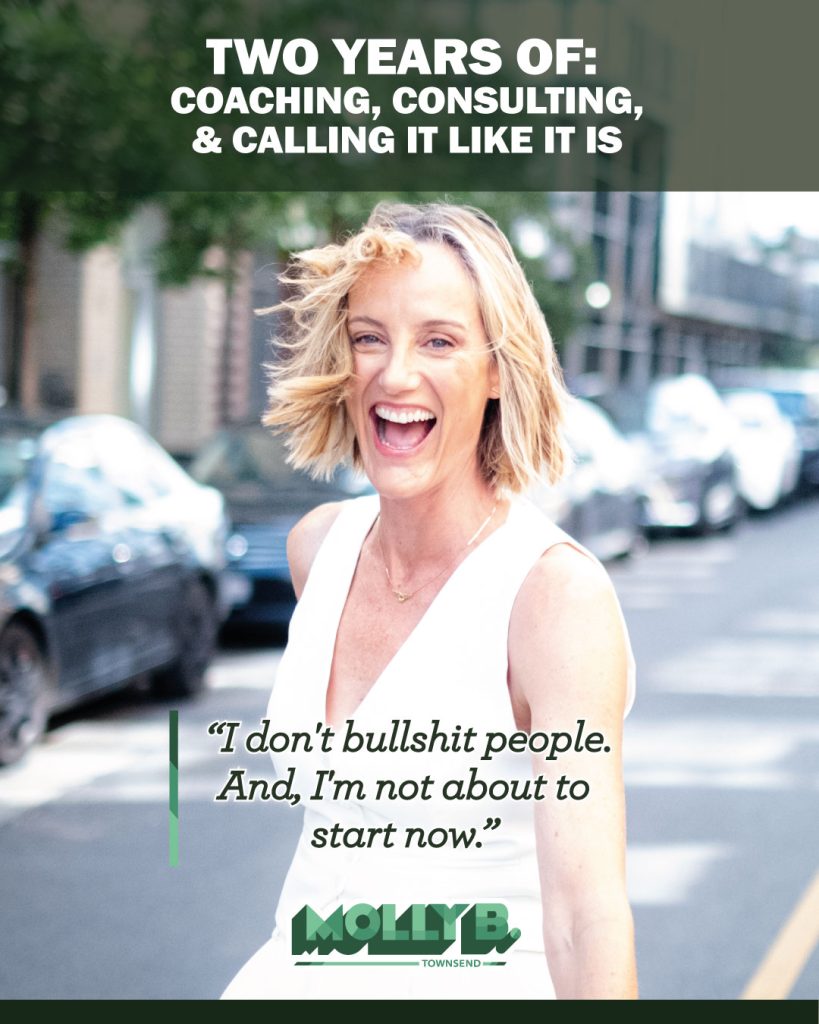



This week marks two years of Molly B. Coaching & Consulting. Two years of big ideas, hard decisions, the occasional existential crisis, and one revelation I keep running into: Knowing better and doing better are two very different things.
There are plenty of schools of thought on what makes a good coach. Some ask carefully crafted questions and wait, patiently, for clients to reach their own conclusions. I ask plenty of questions too. But I also bring 25 years of experience, strong opinions, and a promise I made to myself and the industry: I don’t bullshit people. I’m not about to start now.
To celebrate two years in business, I thought I’d pull back the coaching curtain a little. Here are ten pieces of advice I’ve given, some of them more than once, and stand behind.

Consider this your complimentary session.
1. If you don’t like people, there’s nothing I can do for you.
I can make you a better salesperson. I can teach you to build relationships, ask better questions, and put together a business development plan that works. What I can’t do is make you genuinely interested in other human beings, and in a relationship business, that’s a problem. People can tell when you’re interested in them and when you’re interested in what they can do for you. Curiosity and a real enjoyment of people aren’t soft skills. They’re the foundation.
2. Being well-liked is not the same as being influential.
I’ve met plenty of charming people who can work a room, make everyone feel like their best friend, and leave the meeting with nothing to show for it. Being liked opens doors. Influence moves people through them. At some point you have to stop confusing a good conversation with a productive one. Did you build trust? Did you make your value clear? Did something move forward? If everyone loves you and nobody takes action, you’ve got a lot of friends and not much of a business.
3. Asking for business is the easiest thing you are not doing.
I say this so often I sometimes feel like a broken record. You have wonderful relationships. Your clients adore you. You’ve spent years building a network of people who know, like, and trust you, and then you sit around hoping they’ll remember you when someone mentions they might move. They may not, and it isn’t because they don’t value you. They have their own lives. Asking for business doesn’t turn a relationship into a transaction. It just makes your intentions clear. You don’t have to be pushy. You just have to ask.
4. That’s not the highest and best use of your time.
Just because you can do something doesn’t mean you should. I see talented people spend hours on work someone else could do perfectly well, while the things that actually need their judgment and relationships sit untouched. Sometimes it’s control, sometimes it’s perfectionism, and sometimes the low-value work is simply more comfortable than the high-value work. Being busy isn’t the same as being productive, and neither one is the same as being profitable. Your calendar should reflect what you’re worth, not just what you’re capable of doing.
5. You should not have your own team.
There. I said it. Not every successful salesperson should become a team leader, and some of the best agents I know would be miserable managing people. They love the chase, the relationships, the negotiation, the close. They don’t love recruiting, training, supervising, or managing someone else’s performance, and there’s no reason they should. Building a team is a business model, not a promotion. Before you hire anyone, ask yourself whether you actually want the job that comes with having them. Bigger isn’t always better. Sometimes it’s just bigger.
6. Your brand is smarter than that.
Not every marketing trend deserves your participation. Not every social media challenge needs your take. I’ve watched smart, accomplished people drop their judgment because someone convinced them they needed to be more visible, more relatable, or more like whoever is getting traction this month. Your brand is the sum of the choices you make about how you show up. Have some standards. You don’t need everyone’s attention, just the right people’s.
7. You don’t need to become louder to become more successful.
We’ve gotten into the habit of confusing visibility with value. We look at the loudest people in our industry and assume that’s what success is supposed to look like. It isn’t. Some of the most effective people I know are quiet, thoughtful, and discreet, and they’ve built extraordinary businesses without becoming public personalities. You don’t have to be louder. You have to be clearer about what makes you valuable.
8. If you wait for urgency to create momentum, you’ll spend your career reacting.
Some people are spectacular in a crisis. Give them a complicated transaction, an impossible deadline, or a client threatening to walk, and they come alive. Ask them to spend a quiet Tuesday morning developing new business and suddenly they’re three hours deep in Canva. The trouble with running on urgency is that someone else is always setting your priorities. You have to learn to create momentum when nothing is on fire. The people who build lasting businesses don’t wait for the phone to ring. They give themselves something worth doing before it does.
9. Your imposter syndrome keeps you human.
I’m not convinced every ounce of self-doubt needs to be eliminated. A little uncertainty keeps you curious, humble, and willing to learn. I’ve worked with highly accomplished people who still wonder now and then whether they’re as good as everyone thinks. Sometimes that discomfort is just what it feels like to grow into a bigger version of yourself. What matters is that your insecurities don’t get to make your decisions. You can question yourself without disqualifying yourself.
10. Your self-worth should not be tied to your bank balance.
This may be the most important thing I tell people, and the hardest for ambitious professionals to believe. When your income depends on your performance, a good month makes you feel invincible and a bad month makes you question your entire existence. Your bank balance measures your finances. It doesn’t measure you. You’re allowed to want more, work hard, compete fiercely, and celebrate your wins. Just don’t make your ability to respect yourself depend on the outcome.
Two years in, I’ve learned that coaching is rarely just about business. The business problems change from client to client, but the human ones are remarkably familiar. Ambition, fear, and the stories we tell ourselves about what we’re worth show up in nearly every conversation.
And while I have no shortage of opinions, giving someone good advice is only half the job. The other half is helping them find the nerve to act on it.
Knowing better and doing better are still two very different things.
Thank you to everyone who has trusted me with their ambitions, their doubts, and yes, the occasional existential crisis. It’s a privilege to be in your corner.
Two years down. Plenty more to say.